6,000 process variants. One single procedure.
That's how many municipal variants of company formation the German government counts — and wants to merge. You can only unify what you know. And nobody has ever seen them side by side.
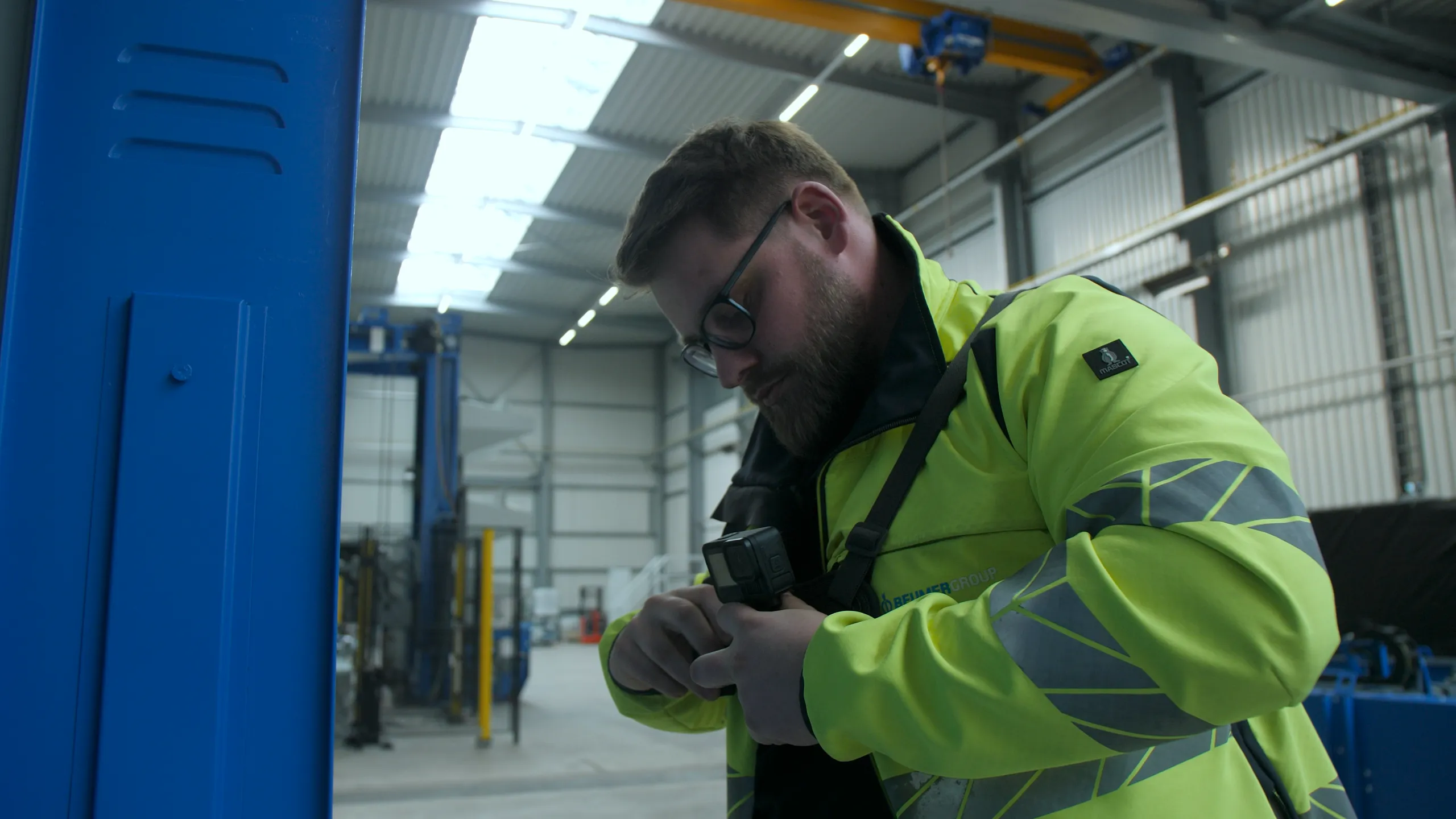
Record processes instead of writing them up. A caseworker does her job once, on camera. Mira turns it into structured as-is documentation — steps, systems, people, exceptions. The foundation for every target process you design afterwards.
Modernization needs a target picture. A target picture needs an as-is state. And almost nobody has one — not through negligence, but because process discovery is expensive, slow and staff-intensive.
That's how many municipal variants of company formation the German government counts — and wants to merge. You can only unify what you know. And nobody has ever seen them side by side.
Applications are filed online and still processed on paper internally. Digitise the surface without understanding the procedure behind it, and the problem stays exactly where it was.
Almost half of Germany's federal, state and municipal workforce leaves by the mid-2040s. With them goes the reason a procedure runs the way it runs. It's in no manual.
Process discovery today costs interviews, workshops and meetings with people who have no time. Mira Guide turns it into a recording.
Screen recording at the desk. Or a phone at the counter. Or dictation on the way to an appointment. No script, no preparation, no camera crew. Your colleague does her job and explains what she's doing — the way she'd explain it to someone new.
A transcript, chapters with timestamps, the individual work steps, the systems and offices involved, the edge cases — plus a knowledge graph linking procedures, systems and people. No editing required. What she mentions in passing — “we do it differently here, otherwise the system crashes” — is now on the record. That part is in no manual.
Record the same procedure in three offices. Mira puts the variants side by side: where the flow is identical, where it diverges, and at exactly which step. The comparison becomes your gap-fit analysis — with evidence instead of assumptions. The knowledge graph also shows what's missing: undocumented procedures, steps only one person knows.
Every recording becomes an illustrated document — PowerPoint, Word, PDF or LLM-ready Markdown, with frames pulled from the video at the right points. That's the source your process team models the target process from. And when someone asks in two years why it was decided that way: the recording is still there. With a timestamp.
The targets are dated: 25 percent lower bureaucracy costs, 223 measures in the federal-state modernisation agenda, eight percent fewer federal staff by 2029. Without a solid as-is state, every target is an estimate. Mira supplies the foundation without you assigning staff you don't have.
Your modelling software stays where it is. Your processes belong in BPMN 2.0. The expensive part comes before: finding out how the process actually runs. Mira turns that into ten minutes of recording — and supplies the raw material for modelling, process repository and case management systems.
Nobody is being filmed here. Someone is showing what they know. The caseworker is the expert, not the measurement object. And the new colleague asks the assistant instead of walking over twice a day — the answer comes with a citation, linked to the exact second in the video where it was explained.
Modernisation agenda, eGovernment MONITOR, dbb monitor. We're not claiming anything — we're quoting.
For company formation alone, the German government counts around 6,000 municipal process variants. You can only unify what you know.
Federal Modernisation Agenda (2025)60 % of Germany's 579 administrative services are digital somewhere. Only 28.5 % are available everywhere. The gap between the two is process variance.
Bitkom (2025)Digital applications are still processed on paper internally. A digital façade changes nothing about the procedure behind it.
eGovernment MONITOR 2025Almost every second person who knows how a procedure really runs will have retired by the mid-2040s. A quarter of them within ten years.
dbb Public Service Monitor 2026Where we stop
Your state has modelling software. Your processes belong in BPMN 2.0. Mira doesn't change that, and doesn't want to. Modelling is how a process is represented. The expensive part comes before: finding out how it actually runs. We supply the raw material. Modelling happens where modelling happens. Through the API and MCP, the result goes wherever it's needed.
An as-is recording doesn't need a real case. A test case in your training environment shows the same clicks, the same system switches, the same edge cases. Real data adds no insight — only overhead. Working with test data is our recommendation, not our fallback.
And if something does end up on screen: the recording lands in the recorder's private space first, invisible to everyone else. In the editor, the spot is redacted. An approval gate decides whether and when the asset becomes visible to the organisation. Access policies then govern who may see it. The archive can delete permanently, when permanently is what you mean. The audit trail records who did what, and when.
Processes are too often too complicated, too expensive and too slow.
Modernisation Agenda for State and Administration (Federal Government), October 2025 — translated from the German original
Mira is built and operated in Germany. In EU data-residency mode all data stays in the EU — including AI model inference. Your data isn't shared with third parties and isn't used to train models. Mira is not open-source software. We'd rather write that down than talk around it. Berlin's open-source strategy pursues a goal we share: sovereignty, the freedom to switch, no dependence on a single vendor. Our answer to exactly those criteria: export any time, no lock-in — your knowledge is yours and leaves with you. Open interfaces through the API and MCP. Model choice is configured per organisation, with no binding to a single provider. And every action is recorded as an immutable event. If you have to justify not choosing an open solution: this list is where that justification starts.
About one specific procedure where you don't know how many different ways it runs. We'll record it, and then you look at the result.
We use necessary cookies to run this site. With your consent we also use statistics cookies (Google Analytics & Google Tag Manager) and load external media (YouTube videos). You can change your choice at any time. Privacy Policy
Necessary
Required for the website to function. Always active; stores no analytics data.