
Knowledge Management: The Practical Guide for Manufacturers
What knowledge management is, why the retirement wave makes it urgent, and how to introduce it in 5 steps – with a methods overview for production and service.

Knowledge management covers every method a company uses to systematically capture, share, and use its employees' knowledge – so it doesn't vanish into heads, binders, and inboxes. In manufacturing, the knowledge that matters most is experience: How do I set up this machine? What does a failing bearing sound like? This guide explains the fundamentals, the main methods, and a 5-step plan for getting started – focused on production and service, not office wikis.
What is knowledge management? Definition
Knowledge management is the systematic handling of knowledge in an organization: identifying, capturing, structuring, distributing, and keeping it current. The crucial distinction is between two kinds of knowledge. Explicit knowledge can be written down – datasheets, drawings, work instructions. Tacit knowledge (experience) lives in heads and hands: the exact movement when setting up a machine, the feel for an unusual running noise, the trick that gets a line restarted. In manufacturing, the most valuable knowledge is almost always tacit – and none of it is in the manual. Knowledge management on the shop floor therefore means one thing above all: making experience visible and transferable before it leaves the building.
Why it is urgent now: the numbers
The baby-boomer cohorts are retiring, taking decades of experience with them. Deloitte and The Manufacturing Institute (2021) project up to 2.1 million unfilled US manufacturing jobs by 2030, at a cost of up to $1 trillion; in Germany, the VDI/IW engineering monitor puts the annual value lost to unfilled engineering and IT roles at up to €13 billion. At the same time, workforces are becoming more international – about one in six working-age Europeans is foreign-born or an intra-EU mover (European Commission, 2024–25) – so knowledge doesn't just need to be captured, it needs to be multilingual. The tools have arrived too: 42% of German industrial companies already use AI in production (Bitkom, 2025). What's lost when an expert leaves only shows afterward: longer changeovers, recurring defects, downtime that used to be fixed in minutes. Securing knowledge is operational risk management, not an HR side project.
The main methods at a glance
There are two basic approaches: codification (knowledge is documented and detached from the person – knowledge base, instructions, videos) and personalization (knowledge passes from person to person – mentoring, communities). Good systems combine both. The most common methods:
| Method | How it works | Strength / limit |
|---|---|---|
| Expert debriefing | Structured interviews with experts before they leave | Deep – but labor-intensive and usually started too late |
| Mentoring / buddy system | Experienced and new employees work in tandem | Effective – but ties up two people and doesn't scale |
| Lessons learned | After projects/incidents: what worked, what never again? | Cheap and fast – fizzles out without a fixed home |
| Knowledge mapping | Visualizes who knows what and where the gaps are | Reveals risk – but secures nothing by itself |
| Communities of practice | Regular exchange between specialists across sites | Keeps knowledge alive – needs facilitation and time |
| Video documentation | The expert is filmed doing the real work; AI structures, translates, and makes it searchable | Captures tacit knowledge where it lives: in the hands. Limit: needs a tool |
For manual work, video is the natural channel: multimedia-learning research (Richard Mayer) shows that demonstration by video beats text specifically for hands-on, procedural tasks. An operator learns the movement by watching – not from section 4.2.1 of a manual.
What's different on the shop floor
Most knowledge management tools were built for desk work: wikis, intranets, document stores. On the shop floor they fail on four counts. Workers don't sit at PCs – knowledge has to reach phones, tablets, and QR codes on machines. Nobody writes a wiki article after a shift – capture has to happen alongside the work. The workforce speaks many languages – monolingual documentation misses them. And it's about hand movements – text and photos often aren't enough. Classic work instructions stay important – but they're the output of good knowledge capture, not its starting point.
Introducing knowledge management: 5 steps
- Identify critical knowledge. Which tasks can only one or two people do? Who retires within 5 years? A simple list (task, knowledge holder, risk) is enough to start.
- Start small – where it hurts most. Don't digitize "the company's knowledge"; pick one line, one team, one process. The pilot's success convinces colleagues.
- Make capture radically easy. The barrier decides everything. Film instead of write: the expert does the job, the video gets transcribed, chaptered, and translated automatically. People who have to fill in forms stop after two weeks.
- Bring knowledge to where the work happens. QR codes on machines, search, and an AI assistant on the phone, answers in each worker's language. A database nobody opens is a graveyard.
- Maintain and measure. Name owners, archive outdated content, close gaps systematically. Metrics: views, questions answered, onboarding time for new hires, repeat errors.
Where AI changes the equation
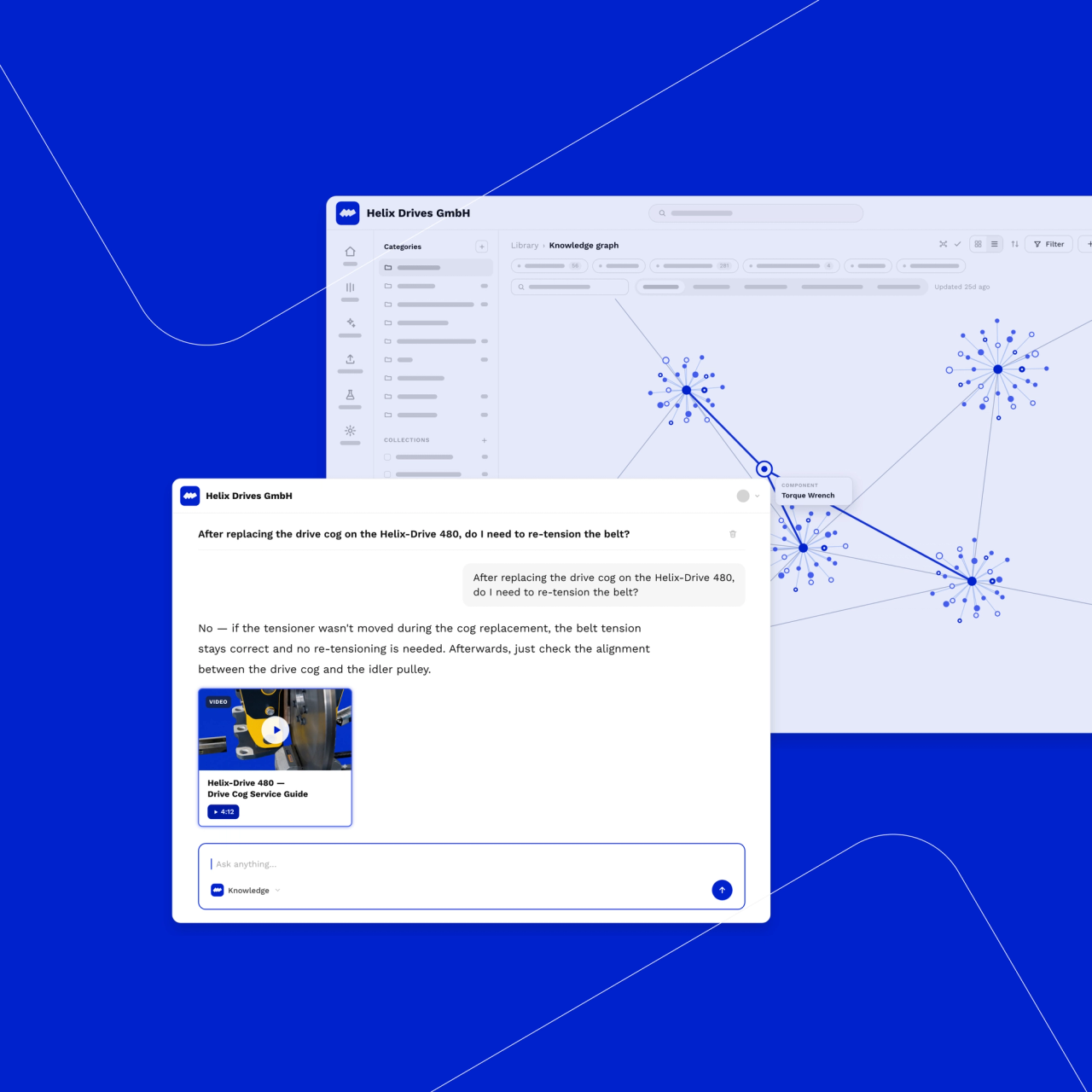
AI changes knowledge management at two points. Capture: from one video it automatically produces a transcript, chapters, summary, and translations – removing the most expensive hurdle, the documentation itself. Retrieval: an assistant grounded in your own knowledge base answers questions directly, with citations. The effect is measured, not promised: +14% productivity on average, +34% for novices (Brynjolfsson, Li & Raymond, NBER 2023) – the people who normally take longest benefit most. See how this looks in practice in our article on work instruction software and the product overview.
Why we think this is manufacturing's most important problem: Why we built Mira.
Frequently asked questions about knowledge management
What is meant by knowledge management?
The systematic handling of knowledge in an organization: identifying, capturing, sharing, using, and keeping it current. The goal: knowledge belongs to the organization, not only to individuals – and everyone can find it when they need it.
What is the difference between tacit and explicit knowledge?
Explicit knowledge can be documented (instructions, datasheets). Tacit knowledge is experience that's hard to put into words: hand movements, intuition, routines. In production, tacit knowledge is usually more valuable, and it's best captured by making a short video, not by writing a text.
How do I start knowledge management in a mid-sized company?
Start small: list critical knowledge, pick one pilot area with real pain, make capture as easy as possible (film, don't write), bring knowledge to the workstation, and name owners for upkeep. A 90-day pilot on one line beats any concept paper.
Which software suits manufacturing companies?
Four criteria decide: mobile shop-floor access (phone, QR code), capture by video instead of typing, automatic multilingual output, and search or an AI assistant that answers with sources. Classic office wikis usually meet none of them. A detailed tool comparison is coming soon in this magazine.
Keep reading
The most practical entry point: document your first task properly – our work instructions guide with free template shows how. How Mira supports knowledge management in manufacturing is on the solutions page.
[NEWSLETTER-CTA – soft conversion per briefing: newsletter sign-up or guide download (frontend form component). No hard demo sell on this page. → Delete quote after embedding.]
About the author: Iaroslav Semenov is CTO and co-founder of Mira. He has spent years working on how hands-on expertise from production and service gets captured, translated, and made usable for entire workforces.


