
Work Instructions: Definition, Examples + Free Template
What a work instruction is, how it differs from SOPs and procedures – with good and bad examples from machine building and a free Word/PDF template.

A work instruction is a document that describes exactly how to perform a single task at a workstation: step by step, with tools, checkpoints, and safety notes. It is written for the person doing the work – unlike a procedure, which describes a process across roles. This guide covers the definition, good and bad examples from machine building, a step-by-step method for writing one, and a free Word/PDF template.
What is a work instruction?
A work instruction (also: standard work instruction, SWI, or job instruction) defines who performs a single task, with what, and in which order. Typical uses in production: machine changeovers, assembly steps, maintenance and inspection tasks, quality checks. The goal is always the same: consistent quality no matter who runs the shift. Good work instructions get new operators productive faster, cut errors and interruptions, and keep expertise in the company when experienced people leave – which makes them a building block of any knowledge management system in manufacturing.
Work instruction vs. SOP vs. procedure
| Document | Answers the question | Typical example |
|---|---|---|
| Work instruction | How exactly do I perform this task? | Changeover of a CNC mill to product B |
| Procedure (QM, ISO 9001) | How does the process run, who is responsible? | Complaint handling from intake to 8D response |
| SOP | Umbrella term; in practice often used for either of the above | Depends on the company's document pyramid |
Rule of thumb: the procedure describes the process, the work instruction describes the task. In an ISO 9001 document pyramid, work instructions sit one level below procedures.
Are work instructions legally required?
Not as a blanket rule – but several obligations effectively require them. ISO 9001 demands documented information wherever it is needed for process quality. EU occupational-safety law requires instruction and training that workers actually understand, and EU machinery legislation requires instructions for use in a language easily understood by operators. German law is the strictest case: safety instructions must be provided "in a form and language the employees understand", and a worker who has not understood them may not be assigned the task at all (DGUV Vorschrift 1). If your workforce speaks several languages, monolingual instructions are a compliance risk, not just an inconvenience.
What goes into a work instruction?
- Header: Title, document number, version, created/reviewed/approved, validity date
- Scope: Which machine, workstation, or product does it apply to?
- Prerequisites: Required tools, material, PPE, qualification
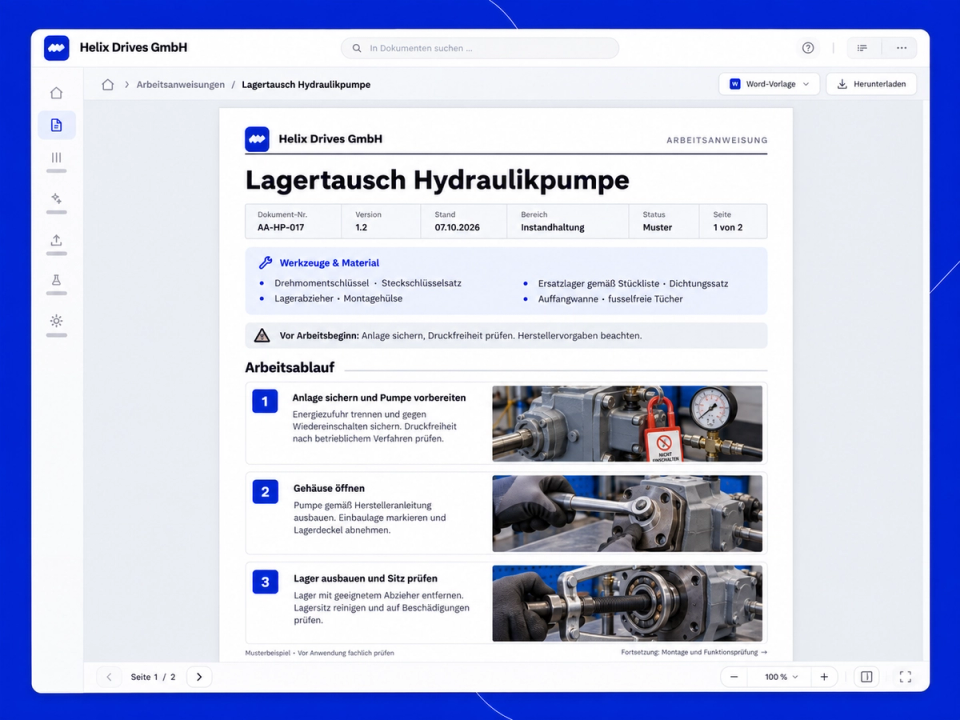
- Steps: Numbered, one action per step, one image per step, concrete values (torque, time, quantity)
- Checkpoints: How do I know the step was done correctly?
- Deviations: What to do when something is off – and who gets informed
A machine-building example: bad vs. good
The bad version – found in real maintenance binders: "Replace bearing. Keep clean." Two sentences that only make sense to someone who already knows the job. No tool, no torque, no press-in direction.
The good version of the same task: "Step 4: Press deep-groove ball bearing 6205-2RS flush to the stop using press-in mandrel (Ø 25 mm). Apply force to the outer ring only. Checkpoint: bearing seats fully, shaft turns without detent torque. If you feel resistance: stop and inform the shift lead." Plus a photo of the correctly seated bearing. The difference isn't talent – it's structure: concrete values, a checkpoint, an escalation rule.
How to write a work instruction in 6 steps
- Define the task and its trigger. One instruction per task. "Maintain machine" is too big; "Replace filter on hydraulic unit" is right.
- Watch the expert work – don't write at a desk. Easiest method: film the task once on a phone. Video captures what conversations lose – hand movements, sequence, tricks.
- Structure the steps. One step = one action. Concrete values instead of adjectives: "tighten to 25 Nm", not "tighten firmly".
- One image per step. Pull frames straight from the video. Visual instructions measurably cut errors: in a controlled study, assembly error rates dropped 82% with visual 3D instructions versus paper (Tang et al., ACM CHI 2003).
- Field-test it. Someone who doesn't know the task performs it using only the instruction. Every question they ask is a gap in the document.
- Approve and keep current. Version, approval date, owner. Define what triggers an update: process change, new tooling, repeated errors.
Free work instruction template (Word & PDF)
The template contains everything from the structure section above: header with version control, tool and PPE list, numbered step table with an image column and checkpoints, plus a filled-in maintenance example. Adapt the Word file to your CI; the PDF version works as a printout at the machine.
From paper to digital work instructions
Word and PDF are a solid start – but paper goes stale, goes unread, and usually exists in one language. The next step is work instruction software: with Mira, you film the expert once – the platform turns it into a structured guide with chapters, transcript, and translation into 14+ languages, exportable as Word, PDF, or PowerPoint. A QR code puts the instruction right on the machine. Built in Germany, hosted in the EU, GDPR-compliant.
Frequently asked questions about work instructions
What is the difference between a work instruction and an SOP?
An SOP typically describes a process across several roles; a work instruction describes one task for the person executing it. Many companies use "SOP" loosely for both – what matters is keeping the two levels separate in your document pyramid.
What language must work instructions be written in?
In a language your workers actually understand. EU machinery legislation requires user instructions in a language easily understood by operators, and national safety law across the EU follows the same principle – Germany even bars assigning a task to a worker who has not understood the safety instructions. For multilingual crews, that means translated instructions are a legal requirement, not a nice-to-have.
Who should write work instructions?
Content: the person who knows the task best – usually the experienced operator or maintenance tech. Approval: the responsible manager or quality function. The proven setup is a duo of subject expert (content) and process owner (sign-off).
How often should work instructions be updated?
Whenever the process, machine, or material changes – plus a fixed review cycle (e.g. yearly). Outdated instructions are worse than none, because they create false confidence.
About the author: Phil D. is Head of Product at Mira, where he works daily with manufacturing teams digitizing their work instructions.


