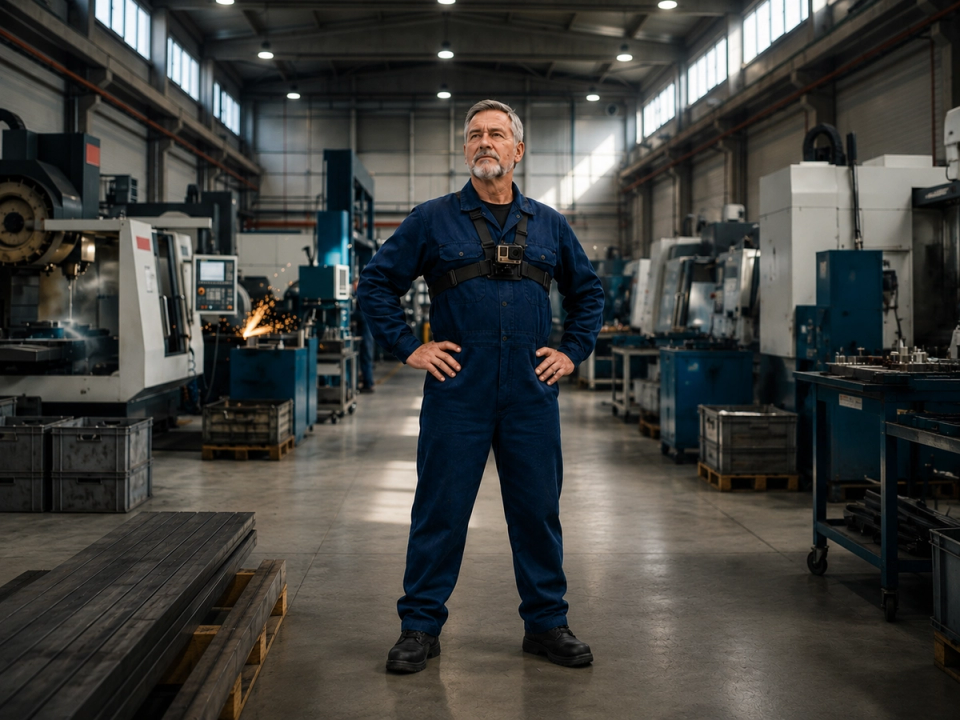
Why we built Mira: capturing shop floor knowledge before it walks out the door.
Manuals capture how a machine was designed, not how it runs. Why practical shop floor knowledge needs video, and what happens when experts retire.

It is fascinating to see how differently companies across industries manage knowledge.
In software and digital product development, we have spent decades building systems that preserve what an organization knows. Developers commit code and document changes. Product managers write requirements. Quality teams create test cases. Sales teams leave behind emails, scripts, CRM histories, and call notes. Decisions accumulate in Jira, Confluence, Notion, GitHub, Slack, and dozens of other systems.
The work itself produces a trail.
As companies grow, this trail becomes essential. New people join every month and have to understand how things work today, as well as why hundreds of decisions were made before they arrived. A good internal knowledge base becomes part of the company's organizational memory, and a key driver of its competitive advantage.
And yet, when we leave the office and walk onto the shop floor, much of this infrastructure disappears.
The most important knowledge lives primarily inside people's heads.
An experienced technician knows how a machine should sound. They know which component to inspect first when a particular symptom appears. They know how much force to apply, where to look, what usually goes wrong, and which shortcut is safe because they have performed the same operation hundreds of times.
Writing all of that down is unintuitive and difficult, and writing itself is often not even the right channel.
Why practical shop floor knowledge is visual
Manuals and technical documentation work well for some kinds of knowledge. A written description can be translated into a mental model and then into action.
For other kinds, text is simply the wrong medium.
You have probably heard the opposite claim, because it is printed in training material across this industry: that most people are "visual learners". That theory, and the "65% of people are visual learners" figure that usually travels with it, has been tested repeatedly in peer-reviewed research, and it does not hold up. It is a myth.
What the research does support is narrower and more useful: for physical, sequential, procedural work, showing beats describing.
The evidence for that is old and solid. In a controlled experiment presented at ACM CHI in 2003, researchers found that visual, spatially anchored 3D work instructions cut the assembly error rate by 82% compared with paper or on-screen instructions. A 2010 meta-analysis by the US Department of Education found that adding video does not improve learning outcomes in general, but individual studies consistently show video ahead of text in one specific category: practical, procedural, hands-on technique. Richard Mayer's research on multimedia learning explains why: words plus relevant visuals beat words alone, because the learner is not spending working memory reconstructing a picture from a description.
The claim is not "people learn by watching". It is "this kind of work is learned by watching".
If you want to explain how to change a setting in an application, text and screenshots may be perfectly adequate.
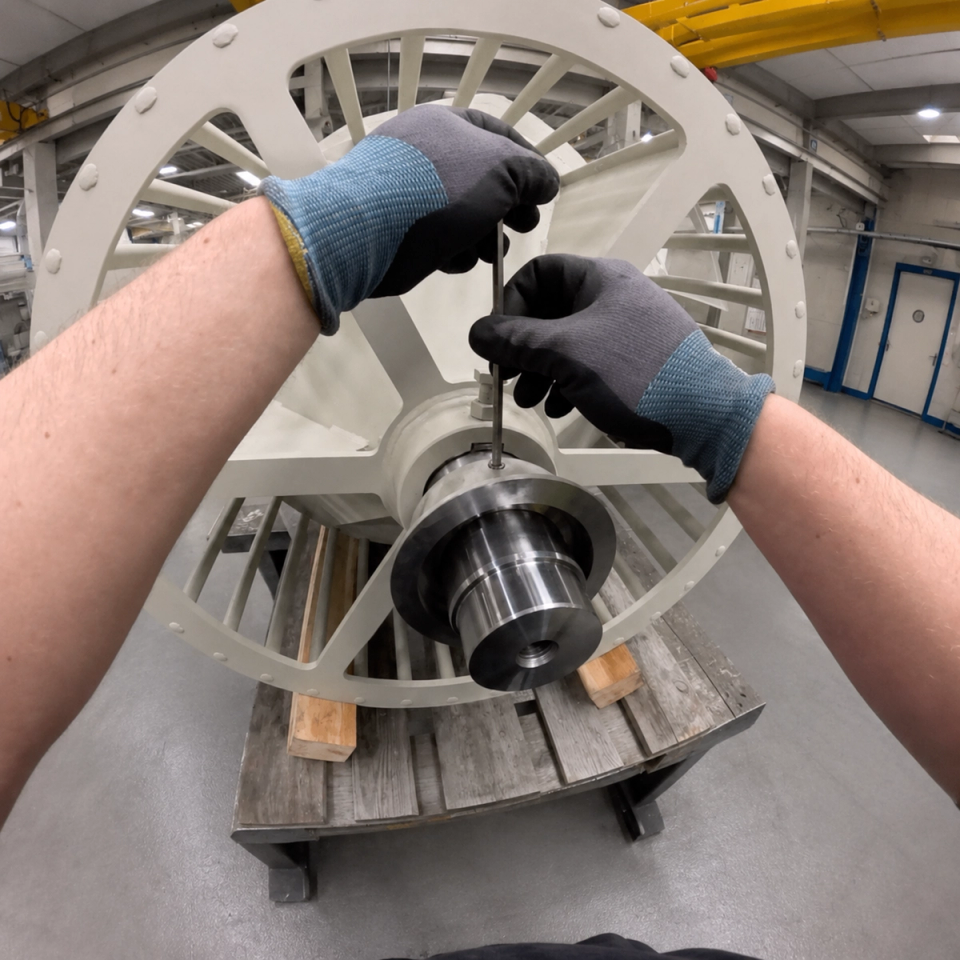
If you want to explain how to repair a bicycle, replace a hydraulic component on an excavator, or perform maintenance on a complex industrial machine, watching an experienced person do it communicates things that several pages of instructions struggle to capture.
You see the sequence.
You see the hands.
You see the tools.
You hear the explanation while the work is actually happening.
And perhaps most importantly, the expert doesn't first have to translate years of embodied experience into formal documentation.
This difference in medium matters because industrial companies face another, much larger transition at exactly the same time.
Experts won't stay forever: the knowledge transfer problem
Across industrial economies, a large generation of highly experienced workers is approaching retirement. This is not simply a hiring problem. It is a knowledge-transfer problem. Companies can hire new technicians. They cannot instantly replace the 20 to 30 years of accumulated experience that leaves with a senior employee.
Manuals and ERP systems do not capture this kind of knowledge, because much of it is tacit and built through repetition, mistakes, observation, and years of solving unusual problems. And manufacturers are already struggling to find enough skilled people to replace those who are leaving.
The German picture has a number attached to it. The VDI/IW-Ingenieurmonitor, published quarterly by the VDI together with the Institut der deutschen Wirtschaft, puts the economic value lost to unfilled engineering and IT roles at 9 to 13 billion euros a year. Over the same period the number of engineering students fell by more than 11% between 2016 and 2023, while the baby-boomer retirement wave accelerates. The VDI's own conclusion is that closing the gap depends on attracting foreign engineers and skilled workers.
That figure covers engineering and IT occupations rather than the shop floor directly, so read it as direction of travel rather than a maintenance-technician headcount. The direction is unambiguous.
On the floor itself the pattern is sharper still, and here Germany has its own number. The Bundesagentur für Arbeit reports that more than a quarter of the workforce in German manufacturing is aged between 55 and 65, against 23% across the economy as a whole, a share that has risen from just under 17% in a decade. Manufacturing and finance are the two sectors furthest into that shift.
The German workforce is ageing, and manufacturing is ahead of the curve
Employees aged 55 to under 65 as a share of the workforce by sector, Germany, 2024
View data – The German workforce is ageing, and manufacturing is ahead of the curve
| Share of employees aged 55–65 | |
|---|---|
| Public administration | 29% |
| Finance and insurance | >25% |
| Manufacturing | >25% |
| All sectors | 23% |
| Health | ≈20% |
Sector shares as published by the BA (rounded; ">" figures are floors). Basis: employees subject to social insurance.
Source: Bundesagentur für Arbeit, Beschäftigungsstatistik
Where the data is more granular still, the same picture holds elsewhere. The Manufacturing Institute found that nearly a quarter of the US manufacturing workforce was already 55 or older, and that 97% of manufacturers report at least some concern about brain drain. Deloitte and The Manufacturing Institute project up to 3.8 million US manufacturing jobs needing to be filled by 2033, with 1.9 million of them at risk of going unfilled.
Those two forces compound each other. There are fewer experienced people available to teach, fewer new people entering many technical professions, and those who do enter have grown up in an entirely different information environment. In the Deloitte and Manufacturing Institute survey work, the single largest driver of unfilled roles was not pay and not location. It was new entrants' differing expectations of the job, named by 38% of manufacturing leaders.
For most of their lives, when they wanted to learn something, they could search for it, watch it being done, and immediately ask follow-up questions. Then they arrive at work and we hand them a PDF.
There is a second shift underneath the first one. The people replacing the retiring generation increasingly do not speak German as a first language. According to the Bundesagentur für Arbeit, around 6.5 million foreign nationals now work in Germany, roughly one in six employees, a share that has more than doubled since 2010. Capturing an expert's knowledge only does half the job if the person who needs it cannot follow the recording.
The technical workforce shows this most clearly. The share of foreign nationals working in German engineering occupations has nearly doubled since 2012, and in 2024 more than four in ten people starting an engineering degree in Germany were foreign nationals.
India has become the largest source of foreign engineers in Germany
Employees with foreign citizenship in engineering occupations, top six countries, Germany, March 2025
View data – India has become the largest source of foreign engineers in Germany
| Employees in engineering occupations, March 2025 | |
|---|---|
| India | 13,997 |
| Türkiye | 9,292 |
| Italy | 6,888 |
| China | 6,761 |
| France | 5,218 |
| Spain | 5,138 |
End of 2012 for comparison: India 2,120 · Türkiye 2,883 · Italy 3,175 · China 2,732 · France 4,079 · Spain 2,767. Over the same period foreign nationals in engineering occupations rose from 46,489 to 120,702 (+159.6%), lifting their share from 6.0% to 11.4%. Basis: employees subject to social insurance.
Source: VDI/IW-Ingenieurmonitor 2025/III; Bundesagentur für Arbeit (special evaluation of the employment statistics)
That mismatch is one of the reasons we believe Mira needs to exist now.
Capturing knowledge cannot become another job
There is another lesson we brought from the digital world.
Even software companies, where practically everybody already works in front of a computer and produces text all day, struggle to maintain good internal documentation.
People are busy.
Documentation becomes outdated.
A developer solves a problem and moves to the next one. A product manager decides in a meeting but never updates the wiki. Everyone agrees that knowledge management matters, yet keeping the knowledge base current continually competes with the actual work.
So how can we expect a service technician or machine operator to do better?
They don't necessarily have a laptop open in front of them all day. Their job is to maintain the machine, assemble the component, diagnose the failure, or get the production line running again.
If knowledge capture requires them to stop doing that job, sit down at a desk, reconstruct what they just did, write an explanation, format it, upload it, tag it, and keep it updated, we should not be surprised when the knowledge base remains empty.
The state of frontline tooling makes the point. In a 2021 survey of 1,000 frontline workers across the UK, US and Canada, YOOBIC found 73% still using paper forms and 40% receiving training no more than once a year. It matches what we see on site.
The mistake is not that the workforce is unwilling to share.
The mistake is designing knowledge-management systems that require them to become knowledge managers.
Our hypothesis with Mira is almost the opposite: capture the knowledge while the work is happening.
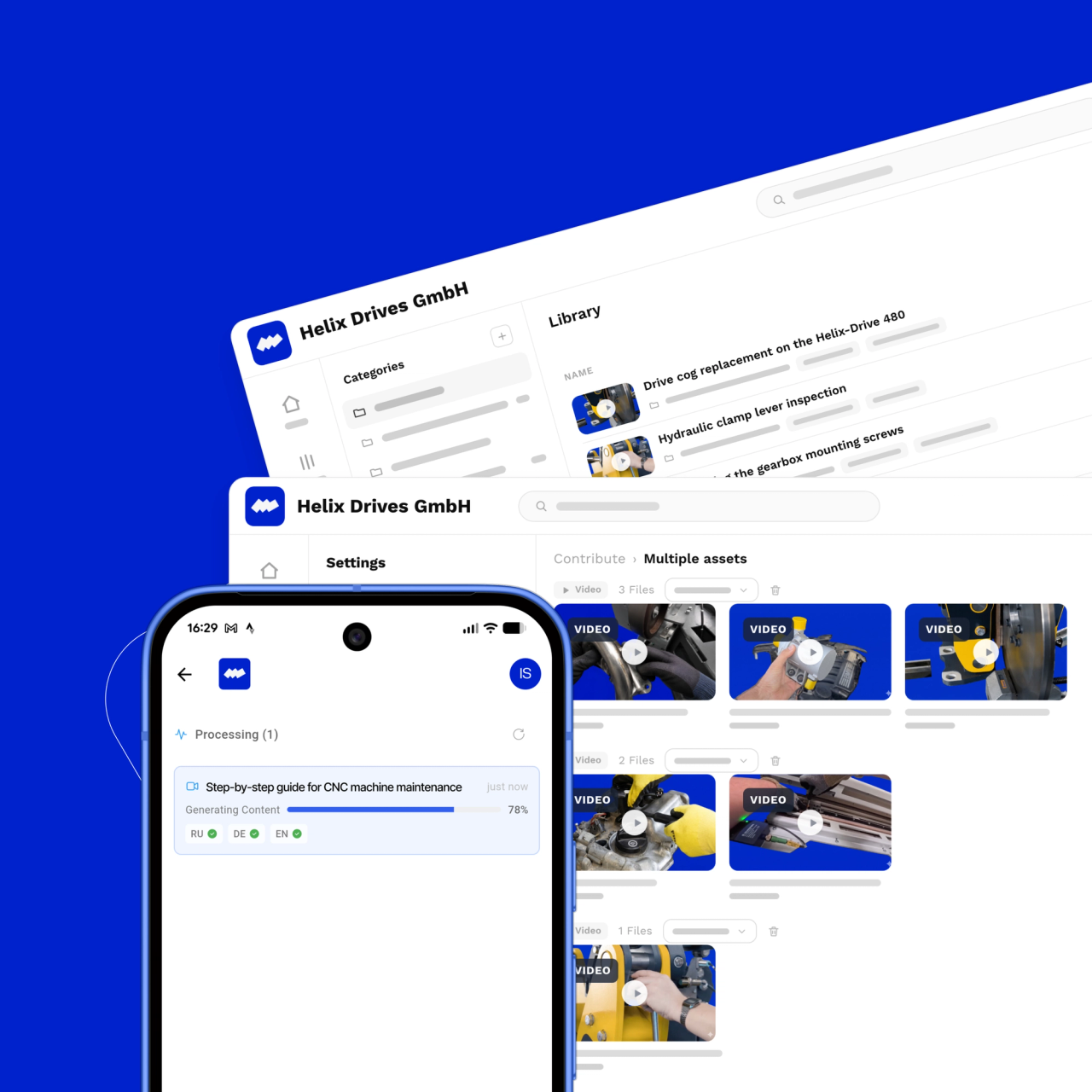
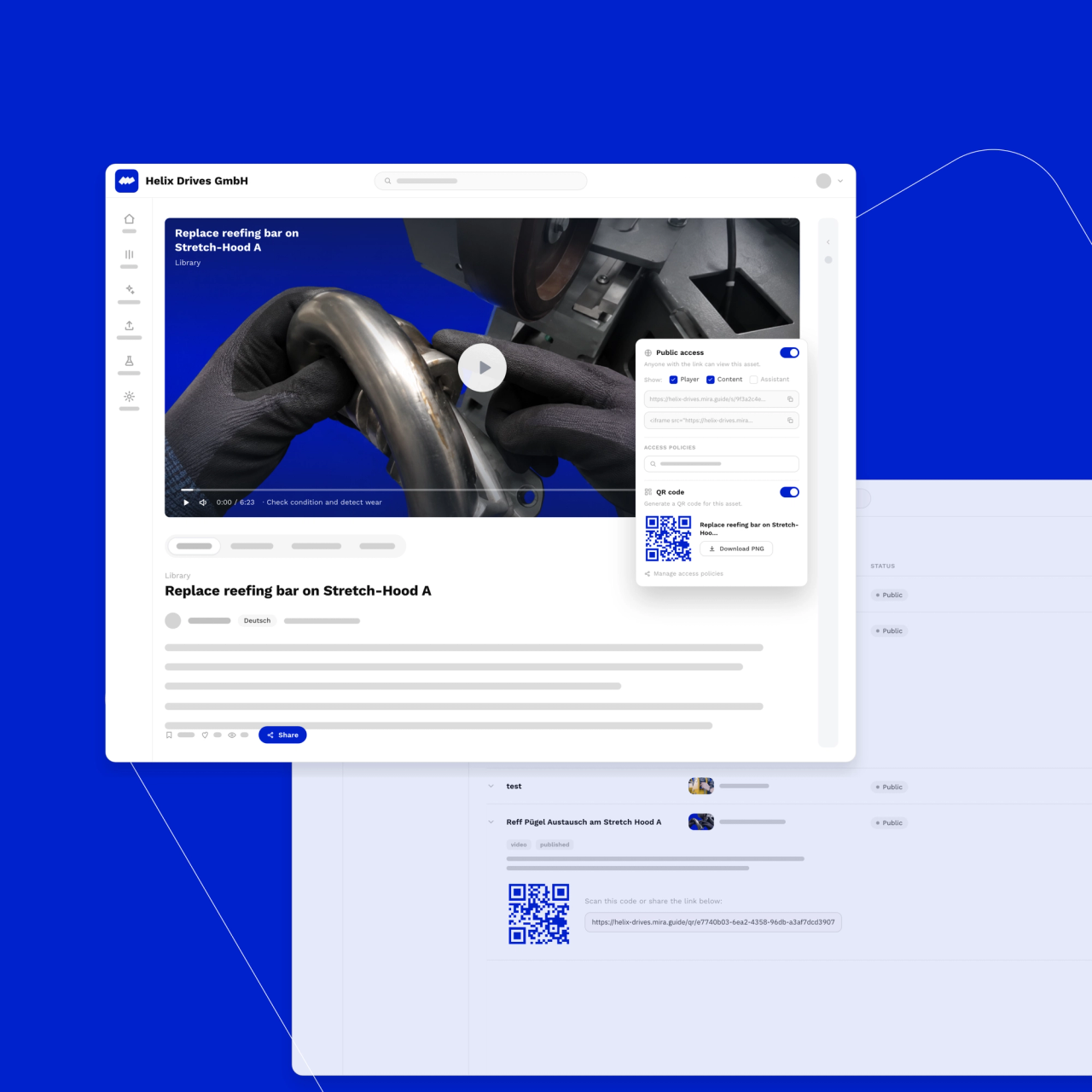
An experienced worker performs the procedure and explains what they are doing. The recording becomes the raw knowledge asset. Mira then turns recordings into structured, searchable and multilingual material, and makes that knowledge available through a conversational interface.
Capture it once.
Use it many times.
The expert is more willing to share than we assumed
One of the moments that changed our conviction happened during an early pilot at a machine manufacturer.
During a session with a service technician, we were recording a maintenance procedure on a complex machine.
Another employee walked past, saw the camera, and asked what we were doing. He got curious.
We explained the experiment.
His reaction was basically: Can I try it?
Within perhaps thirty seconds, the camera was strapped to him. He started performing the procedure and narrating what he was doing as naturally as if he had been making instructional videos for years.
Nobody had to persuade him.
Nobody had to put him through a workshop about knowledge management.
He understood the idea immediately.
Then he saw what happened after the recording was processed. What had just been an informal recording of his work became something other people could navigate, search, and ask questions about.
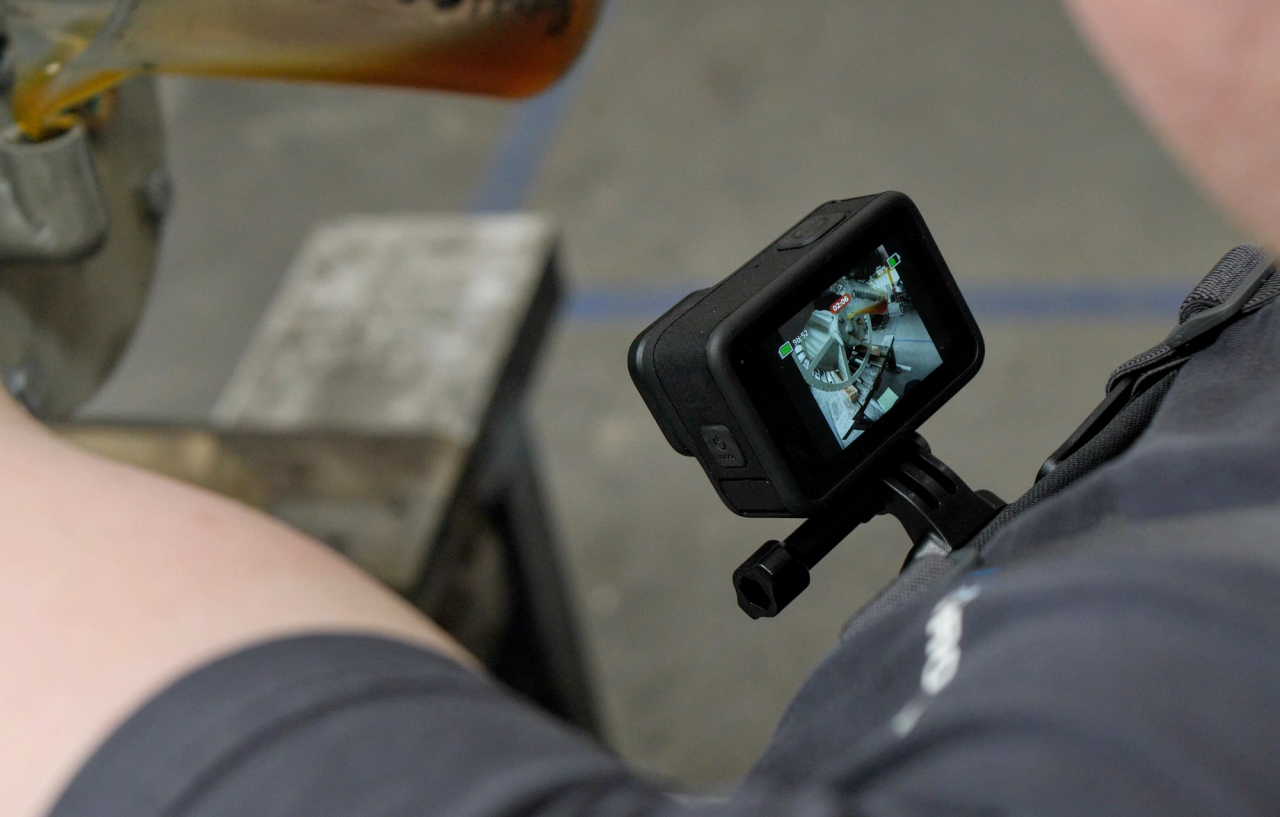
That moment was important for us because we repeatedly heard the opposite assumption elsewhere.
At trade fairs and in conversations with manufacturing companies, people working on the office side would sometimes tell us that shop-floor employees would never want to record themselves or contribute knowledge like this.
Our experience on the shop floor was very different, and the obstacle was not willingness.
It was friction.
We are not the only ones finding this. Microsoft's Work Trend Index surveyed 9,600 frontline workers across eight industries and eight markets, and found 63% of them excited about the job opportunities new technology creates. Asked what would actually reduce their stress, they ranked better technology third, behind only better pay and more vacation time, and ahead of almost everything else management could offer.
That survey measures the appetite for better tools rather than the willingness to record a procedure. But the direction matches what we saw in the pilot, and it sits on top of a long-standing imbalance: an estimated 80% of the world's workforce is deskless, and that 80% has historically received roughly 1% of software investment, by Emergence Capital's estimate.
The appetite has been there for years. The tools have not.
That distinction fundamentally shaped how we think about Mira.
Knowledge capture has to be almost non-disruptive.
The expert should not have to become a technical writer.
They should be able to do their work, explain what they are doing, and move on.
The shop floor wants AI too: what frontline workers actually say
There is another assumption we think is becoming outdated: that AI is primarily a technology for office workers.
Machine operators, service technicians, and field technicians are not a different species of human being. They use the same phones, search for answers online, and increasingly use AI in their private lives.
It would be strange to expect them to walk into work and suddenly prefer a 20-year-old information experience.
The adoption data has already moved. Bitkom's representative survey of 552 German manufacturers with 100 or more employees, published in March 2025, found 42% already using AI in production and another 35% preparing to. Three in four are in or approaching the shift, and 82% say AI will be decisive for the competitiveness of German industry. The same survey found half of them waiting to see how others fare, and 46% worried that German industry is sleeping through the change.
Read the 42% precisely. It covers AI in production broadly, including machine monitoring, robot control and energy optimisation, not assistive AI in a technician's hand. Across the German economy as a whole, Bitkom found AI use doubling in a year, from 20% in 2024 to 36% in 2025, with only 17% of companies still calling it "not a topic", down from 41%. Globally, Deloitte's 2025 Smart Manufacturing and Operations Survey of 600 executives found 24% had deployed generative AI at facility or network scale, with 38% piloting.
So the real question is not whether the shop floor will use AI. The question is what survives contact with a shop floor. McKinsey's State of AI puts organisational generative-AI adoption around 78%, while only a single-digit percentage have scaled it to measurable bottom-line impact. MIT's figure for pilots that reach measurable P&L impact is around 5%.
We do not think that gap is mysterious. Most shop-floor AI is not grounded in the company's own machines, procedures and vocabulary.
Generic answers and long prompts are not enough. The system has to understand real machines, real procedures, and real company knowledge, and connect answers back to trusted sources. Voice, video, and mobile-first interaction become essential. Mira is built around this idea, grounding answers in actual recorded work and linking back to the exact source moment.
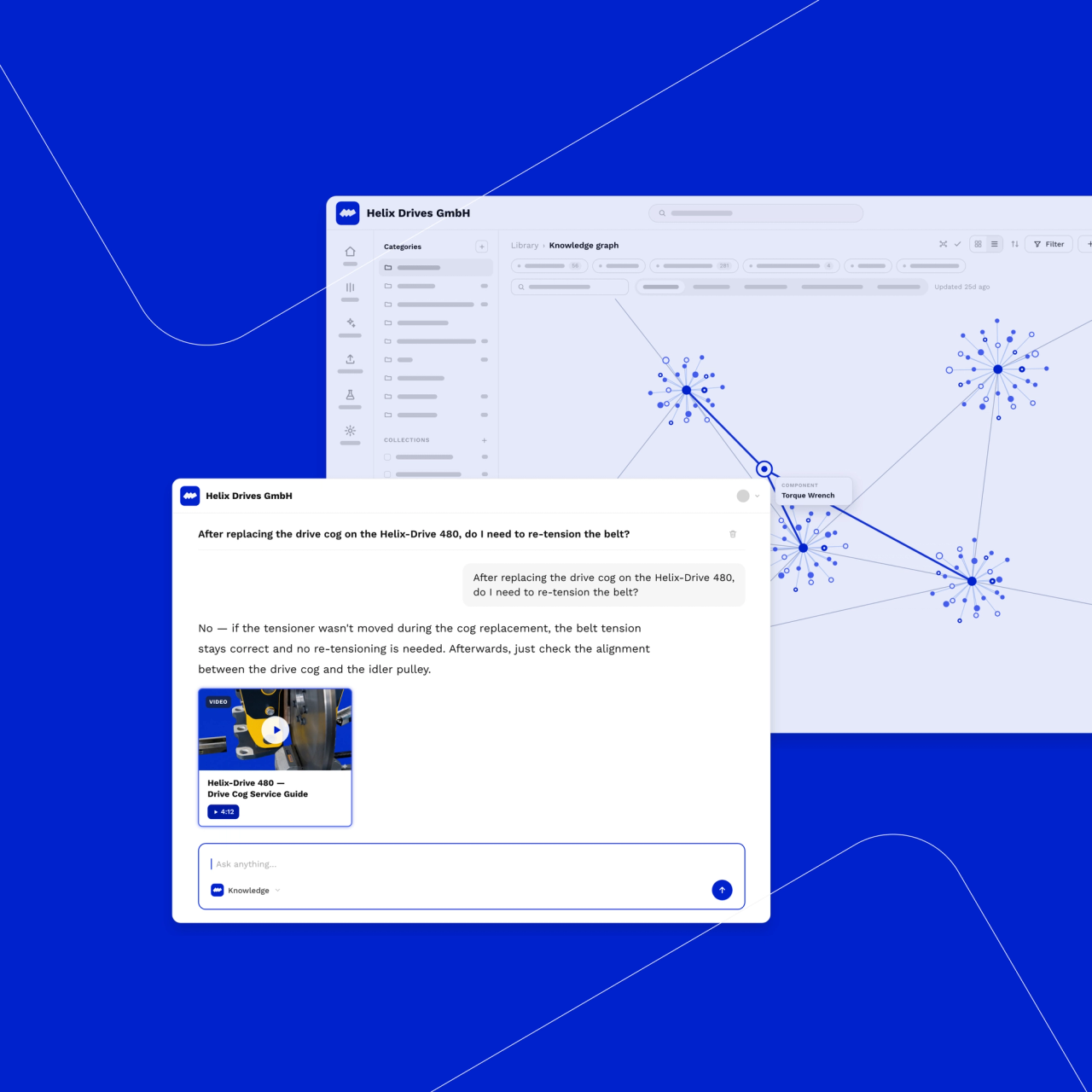
One more number from the same Bitkom survey is worth stating plainly, because it is also our own position: 93% of German companies would prefer their AI to come from a German provider. Mira is built and hosted in Germany, and the data stays in the EU.
The point is not to bring AI onto the shop floor because it is fashionable. It is that AI finally fits the way this kind of knowledge is created and used. A worker should not have to search through a manual or navigate layers of documentation. They should simply be able to ask.
From knowledge loss to knowledge compounding
There is also a more human outcome we hope to create.
Imagine an experienced technician who answers the same question over and over. A colleague calls on Monday. A different colleague calls three weeks later. Then another site calls with the same fault. Their expertise is valuable, but access always means interrupting them again.
That cost is measurable at both ends. McKinsey Global Institute put the time employees spend searching for and gathering information at roughly 1.8 hours a day, close to 20% of the working week, and found that a searchable record of company knowledge can cut that search time by as much as 35%. The report dates from 2012; nothing since has made the problem smaller. In field service, Aberdeen's benchmark first-time-fix rate sits around 75%, which means roughly one visit in four needs a repeat, and about 25% of those repeat visits happen because the technician did not have the right skills or knowledge on site.
Stop interrupting experts to reuse their knowledge
Now imagine they demonstrate the procedure once. Months later, hundreds of people have watched, searched, or solved the problem through that single recording.
And the people who gain most from that are exactly the people replacing the retiring experts. In the largest and cleanest study of an AI assistant at work, published in the Quarterly Journal of Economics, researchers tracked 5,179 customer-support agents and measured a 14% average productivity gain, rising to 34% for novice and low-skilled workers, with minimal effect on the most experienced. The same study found the assistant improved English fluency, particularly among international agents.
That pattern repeats wherever it has been tested rigorously. Developers given an AI pair-programmer finished a coding task 55.8% faster in a controlled trial, and the largest gains went to the least experienced. In a field experiment with 758 Boston Consulting Group consultants, AI users produced work rated roughly 40% higher in quality and worked 25% faster, and again the biggest gains went to below-average performers. A study of 263 clinicians published in JAMA Network Open found burnout falling from 51.9% to 38.8% after thirty days with an ambient AI scribe.
Developers, consultants and doctors have all been handed an assistant that makes the hard parts easier. The service technician has not. Yet.
The same knowledge keeps helping without repetition. The efficiency is obvious. But there is something else too: pride. Seeing your accumulated experience used across the organization changes how that knowledge feels. It is no longer something that disappears after each shift, but something that compounds over time.
Turn experience into long-term, reusable value
That is the shift we are interested in. Digital companies have learned to turn everyday work into lasting organizational knowledge. Industrial companies should have the same ability, not by turning the shop floor into an office, but by building systems that fit how physical work actually happens.